
What sticks?

THE PREFERENCE OF TIME is said to vary among peoples. This is one of those nuggets of sociology, like the collectivism/individualism distinction, where the facial truth of it seems obvious but any attempts to extract usefulness from it seem dubious. In its current form, time-preference is akin to the “Protestant work ethic,” a concept more likely to be passed on as historiography rather than scientific study.
Studies based on survey data show that the use of futureless [weak future time reference (weak-FTR)] languages, which grammatically associate the future and the present, tends to correlate with more future-oriented behavior on the part of people and organizations. Thus, for example, across and within countries, speakers of such languages save more, retire with more accumulated wealth, smoke less, practice safer sex, are less obese, and care more about the environment.
Ian Ayres, Tamar Kricheli, and Tali Regev. “Languages and future-oriented economic behavior—Experimental evidence for causal effects,” PNAS 120 (7)
So if I may offer my own unscientific theory of time and culture, without any pretense at a serious analytical framework.
Every human culture has three notions of time: linear time, cyclic time, and end times. Modernity introduces exponential time, which reduces to linear time under the logarithmic transform.
Success at business requires all three.
To grow a business, one requires consistent compounding in exponential time.
To survive, one never forgets the boom and bust cycle.
To raise capital from venture capitalists, one becomes fluent in the millenarian terms of network effects and platform dominance that are realized once t = ∞.
Winners fixate on exponential time. Losers find solace in cyclic time. Both relish the moral clarity of end times.
Riding high, the Republican establishment imagines that they have a mandate to axe Pax Americana. To hew an international order that is rigged in favor of American interests to instead serve parochial grievances. All of the adherents of MAGA placed in various policy domains, Bessent in Treasury, Hegseth and Waltz in national security, and RFK Jr. in health and human services, were confirmed in party-line votes , putting to bed any notion of a separation between establishment and insurgent.
In the opposite corner, the Democratic establishment expects to reap gains in the upcoming midterm elections. They, along with prestige political media, are fond of the word “shellacking,” the insight that the consequence of taking any substantive action is always electoral loss.
They are both correct—within their respective dimensions of time
Even if they are quickly reversed, the massive disruptions to the federal government under DOGE, from as pettifogging a move to shutter call centers for social security, are perfectly tailored to antagonize old people, federal employees, and all the demographics that turn out in midterm elections.
But perhaps, it will play out differently this time. So thinks every challenger candidate in a low-turnout election who has found themselves wishing for a groundswell of supporters to materialize at the eleventh-hour on election day. It is almost always a losing bet. Such is the beauty of voting. That what seems like the whims of the rabble are actually, in aggregate, a very exquisite sorting machine. The type of rabble who show up in off-cycle and midterm elections are an oddly consistent bunch.
But the picture shifts when zooming outside of cyclic time. It would be unwise to read midterm victory for the Democratic party as anything substantive. At the federal layer, Democrats are genuinely unpopular. In the last election cycle, pragmatic down-ballot candidates, both progressive or moderate, kept up the yeoman’s work of bailing out the deeply-despised party leadership. This is a recipe for failure and opens the path for more people to just give up and run as independents, Republicans, or leave politics altogether. You can only let down people so many times before they also are forced to give up on you.
Why the pessimism? Because the American centre-left’s dilemma is a well-documented one, replicating across the pond in the United Kingdom. In many ways, the United States is a remarkably stable polity. It has been relatively untouched by war. The death toll of 60,000-odd Americans accumulated from its various forever wars stack up to less than one year of Russian war dead in Ukraine. Without a conventional war, famine, and civil strife, the American economy has mostly grown unchecked. The main exception, financial collapse, has become itself a recurring facet of creative destruction, where bailouts ensure that the full voting citizens of the American enterprise, its asset holders, always notch a new all-time high.
This concentration of wealth has not been a politically neutral development. Like tax-cheats shopping for tax havens, they have dealt transactionally with political parties. They enjoy a cozy relationship with both parties, especially the Democratic one, with the implicit but actionable threat that should the party turn against them, they could easily yank their capital for green pastures. Thus, corporate profits grow as the regulatory attention on banking, anti-trust, and the basics of life wane. Even some capitalists, short-sellers at the margins of Wall Streets, have griped that the game of capital allocation should be a bit more difficult than this.
At this point, it’s not necessarily even that parties are corrupt—although they certainly are—but that parties genuinely believe in being good stewards of the public interest, where the common prosperity that underpins political stability can only be cultivated by pro-business thinking. In Democratic circles, moderating on policy has often meant cycling between vagueness or hyper-focus on policy specifics that no normal human being bothers with, but always in ways that either consciously or consciously defer to the self-important instincts of asset managers and CEOs.
It has been a giant ratchet operating in exponential time, where everyone except the rich have seen their political influence dwindle. Unions are a shadow of what they were. All other blocs, the evangelical bloc, the pro-Israel bloc, have all made their alliances with business interests. The rise of Musk as a co-president is not anomalous. It’s just that Bezos and the others would have preferred to be subtler.
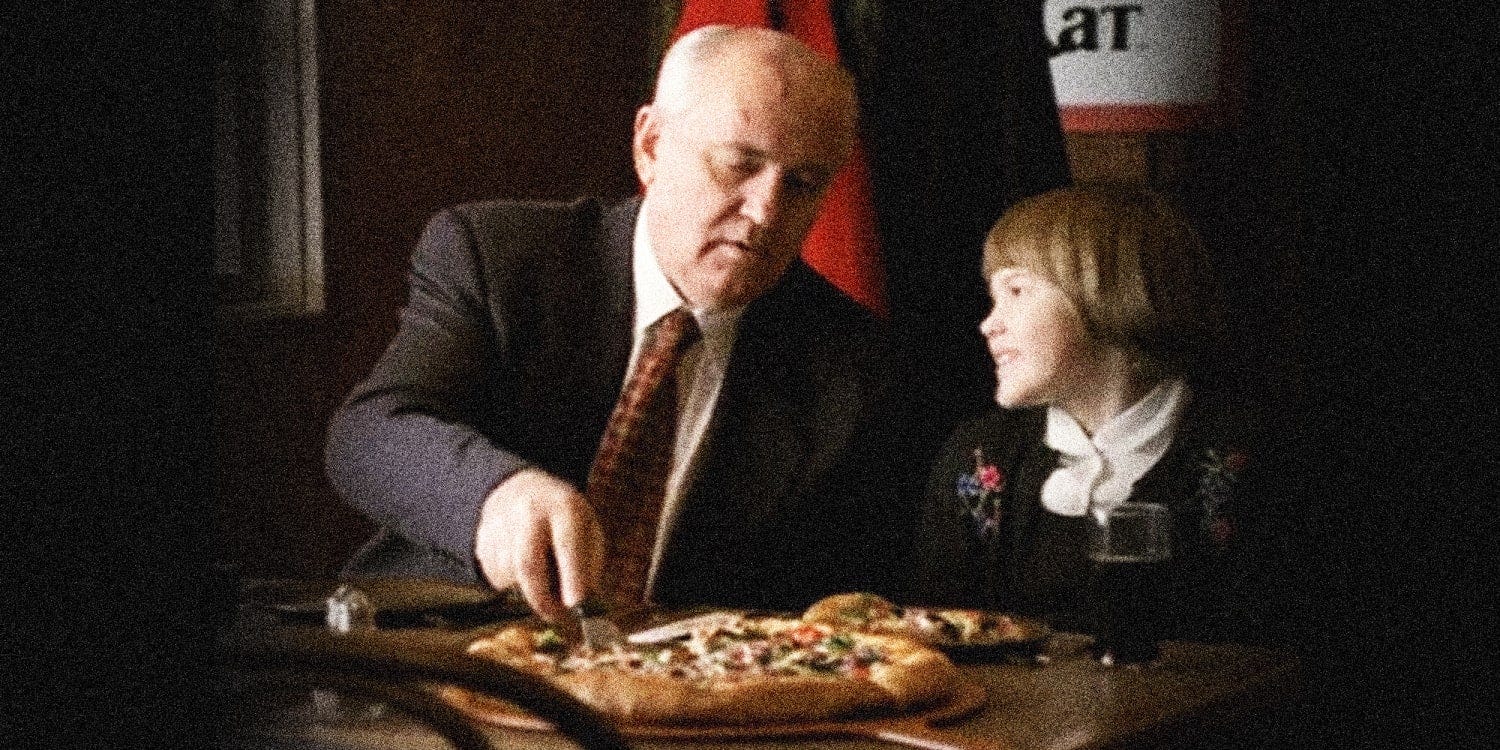
If the Democrats feel outmatched by Republicans in the culture war, the solution is not to search for centrist podcasters to wage a diet version of red-meat rhetoric. It should be to open a new front by engaging in materialist politics. However, that would involve antagonizing entrenched economic interests, a sore point historically. When the liberal hero Gorbachev tried to go against the various state-owned enterprises of his day, the collective farms, the military-industrial complex and the like, the restructuring of the Soviet economy went about as well as you’d expect…
A-breakin' rocks in the hot sun
I fought the law and the law won
I fought the law and the law won
There are scars, decades deep, planted within American society. Both parties have overseen massive economic gains—not inherently a bad thing at all!—that broadly failed to trickle into living standards if not for the enforced benevolence of Chinese factory workers deferring their own happiness to give Americans whatever they wanted. Massive waves of de-regulation and offshoring unambiguously increased GDP while also rewiring the economy so that less of that GDP share went to normal people. There was nothing natural, inevitable, or irreversible about this process. This aligned with other cultural trends since the post-war era. Onwards from the 60s, as the Democrats became more professional, college-educated, and urban, they were more comfortable negotiating with corporate interests they distrusted over the messy, anachronistic politics of populism and local interests.
The result today is a paradox. At the same time that the nation has achieved perhaps the most tolerant culture in U.S. history, the destruction of the anti-monopoly and anti-bank tradition in the Democratic Party has also cleared the way for the greatest concentration of economic power in a century. This is not what the Watergate Babies intended when they dethroned Patman as chairman of the Banking Committee. But it helped lead them down that path. The story of Patman’s ousting is part of the larger story of how the Democratic Party helped to create today’s shockingly disillusioned and sullen public, a large chunk of whom is now marching for Donald Trump.
Matt Stoller, “How Democrats Killed Their Populist Soul,” The Atlantic
Beyond those “Watergate Babies,” American history includes various strands of materialist politics, socialism being a major one. But it is strange to be entertaining the debate about socialism within the United States when the unionization rate of waged employees have consistently stayed just shy of 10%. Thus, much of modern socialist discourse is a negotiation between emphasizing material versus cultural politics rather than a stable fusion of the two.
As a result, the coalition of what we can broadly call “the Left” is hemorrhaging voters without college degrees after going all-in on the hope-and-change slogan of the last charismatic Democratic candidate. The opposite coalition, spreads beyond the so-called white working class to really any demographic except for the en-diploma’ed.
One of my favorite stats on this is something that Nate Cohn put out a couple years ago: Working-class white voters who’ve read a book in the last year are much more Democratic than working-class white voters who haven’t.
Eric Levitz, “This is why Kamala Harris really lost: TikTok is making young voters more Republican?,” Vox.
Unless Democrats confront their history, they will only win in cyclical time. They will be the uncharismatic rebound that voters relapse to when the other side inevitably burns their hand on the stove. And every time the cycle resets, it resets at a level that shifts the electorate rightward, away from a centre-left mired in circular firing squad debates about “messaging.”
Collectively, we need to start thinking about end-times and ask where does the ratchet take us. Because currently, American democracy is a contest between two factions who don’t care about it. If the establishment right is actively dismantling the small-r republican values of the founding, the establishment left is, by refusing to defend those values, corroding the almost 250-year-old enterprise by its passive faithlessness. The question of democracy will no longer be a discussion about institutions but a narrow obsession about the integrity of the ballot-counting process and quibbling about which classes of people can be snatched off the street. Things that American political scientists have traditionally chastised other regimes for.
I don’t think a third party or a strong independent faction necessarily helps things, but we could stand to benefit from third spaces where sane people who believe in basic values of freedom can gather along their own lines, with message discipline naturally looser in positive ways. Gambling that a single political party—one that has repeatedly failed—will spin up a national messaging apparatus that is also broadly popular seems suicidal.
Winning takes work.
So much work that you may even become sick of winning when the time comes.
Further reading on what the privatization/looting of the state (part of the big ratchet) looks like: Trump’s Antisocial State